


Introduction: One Night, One Monologue, and Suddenly Everyone’s Talking
Have you ever said something in the moment — maybe in frustration or in jest — only to have the whole world react like it was a declaration of war? Yeah, we’ve all been there. But for Jimmy Kimmel, a late-night talk show host known for his sharp humor and pop culture takes, one monologue about the tragic killing of conservative activist Charlie Kirk didn’t just make headlines — it shook the media world. It pushed networks, critics, politicians, and everyday people into heated debate.
And honestly, that makes you wonder: what did jimmy kimmel say about charlie kirk — and how did it turn into a national firestorm?
In this article, we’re going to unpack the context, the words, the reactions, and the deeper meaning behind one of the most talked-about media controversies of 2025. You’ll get the full story, told like you’d hear it from a friend — clear, candid, and thoughtful.
The Story Behind the Controversy
Charlie Kirk’s Death and the National Reaction
To understand Kimmel’s comments, we need context first.
Charlie Kirk, a well-known conservative commentator and founder of Turning Point USA, was shot and killed during a campaign event in Utah in September 2025. His death shocked both sides of the political aisle, leading to widespread commentary and public reactions.
And that’s where Jimmy Kimmel’s monologue comes in.
Jimmy Kimmel’s Monologue: What He Actually Said
On a September episode of Jimmy Kimmel Live!, Kimmel addressed the incident during his opening monologue and made several pointed remarks that sparked controversy. Many reactions zeroed in on a key part of his message.
In his monologue, Kimmel said:
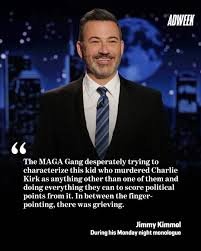
“We hit some new lows over the weekend with the MAGA gang desperately trying to characterize this kid who murdered Charlie Kirk as anything other than one of them and doing everything they can to score political points from it.”
Pause for a second. Read that again. Notice how that construction focuses on reaction to exploitation of the tragedy, rather than making a claim about broad political guilt.
But Kimmel didn’t stop there.
He also mocked the national leadership’s response to Kirk’s death. For example, Kimmel showed a video of former President Donald Trump being asked how he was doing and then shifting immediately to talk about White House construction, quipping:
“This is not how an adult grieves the murder of somebody he calls a friend. This is how a four-year-old mourns a goldfish.”
That line — biting, sharp, and very much in the late-night style — became a focal point for critics.
What He Meant — And What He Says Now
Kimmel’s Clarification and Emotional Response
After widespread backlash — including temporary suspension of Jimmy Kimmel Live! from several ABC affiliates — Kimmel returned to the air and clarified his intent.
Looking emotional and serious, he said:
“It was never my intention to make light of the murder of a young man.”
“I don’t think there’s anything funny about it.”
“Nor was it my intention to blame any specific group.”
So, to be clear: his stated aim was not to celebrate the death or to suggest support for violence. Instead, he framed his comments as criticizing how some political actors allegedly used the tragedy to score points.
And there’s a very human side to this — Kimmel appeared genuinely emotional, even tearful, as he expressed that sentiment on his return episode.
Kimmel’s Defense: Mischaracterization
In an interview later on, Kimmel said his original remarks were “intentionally and maliciously mischaracterized” by conservative media critics, arguing that the fuss was over interpretation rather than substance.
From his perspective, he saw it as a commentary on political behavior — not an attack on an individual’s memory.
The Fallout: Suspension, Free Speech Debate, and Public Outcry
Suspension of the Show
One of the most dramatic outcomes was ABC pulling Jimmy Kimmel Live! off the air temporarily after the comments. Several big station owners — including Nexstar and Sinclair — refused to broadcast the show.
This wasn’t a minor news item. It sparked fierce debate about freedom of speech, media censorship, and the role of political satire. Some argued networks were bowing to pressure, while others felt the comments were inappropriate given the recent tragedy.
Political and Public Reactions
Critics, including former President Donald Trump, hailed the network’s decision to distance itself from Kimmel. Proponents of free expression, including many entertainers and Democratic figures, slammed the suspension as censorship.
It became more than a media story — it turned into a cultural flashpoint about how we talk about politics, tragedy, and satire in a deeply divided nation.
Breaking Down the Key Messages
Now that you know what was said, let’s talk about what it meant on a deeper level.
1. Satire and Sensitivity
Late-night hosts like Jimmy Kimmel have a long tradition of mixing comedy with commentary. But tragedy poses unique challenges — especially when emotions are raw.
So yes, context matters — and so does delivery.
2. Misinterpretation Matters
Once a public figure says something, especially on live TV, it’s out there. Interpretations vary wildly depending on political lens — and sometimes people hear what they expect to hear.
Kimmel himself acknowledged that some found his comments “ill-timed or unclear.”
3. The Role of Media in Politics
In an era where late-night comedy often intersects with political criticism, this controversy highlights how fragile that balance can be.
Jimmy Kimmel’s Broader Career, Context, and Resilience
It’s worth noting that Jimmy Kimmel has been doing Jimmy Kimmel Live! for decades. He’s a veteran entertainer and often merges humor with social commentary.
So when this incident happened, it was not because he’s new to political humor — it was because the subject was deeply sensitive and raw, and reactions were amplified by a polarized political climate.
Interestingly, after his temporary suspension, the show returned with record ratings, suggesting that viewers wanted to hear his voice amid the controversy.
What This Says About Comedy and Modern Media
Comedy has always pushed boundaries. But in 2025, when political polarization is so sharp, even a single line can spark fierce debate.
Jimmy Kimmel’s comments about what he saw as political opportunism in the wake of a tragedy show how late-night hosts aren’t just entertainers — they’re commentators for an age where humor, politics, and media clash daily.
At the same time, his emotional explanation of his intent shows a human side we shouldn’t ignore — behind the jokes is a person wrestling with how to speak about pain, grief, and politics in a fractured society.
Conclusion: Words Matter — But So Does Intent
So what did Jimmy Kimmel say about Charlie Kirk
He criticized what he saw as political exploitation of a tragedy.
He used satire to comment on leadership reaction.
He showed emotion and clarified that he did not mean to mock the death itself.
The result? A major media event that forced the public to grapple with where comedy ends and sensitivity begins — and how free speech and media responsibility intersect.
It’s a reminder that in today’s world, every word counts — and every audience hears it differently.
FAQs (Short Q&A)
Q1: Why did Jimmy Kimmel’s comments about Charlie Kirk cause controversy?
Jimmy Kimmel commented during his monologue that some political actors were trying to use Charlie Kirk’s death for political gain, which many listeners found offensive or insensitive.
Q2: Did Jimmy Kimmel mock Charlie Kirk’s death directly?
No — Kimmel clarified that he did not mean to make light of Kirk’s death and expressed heartfelt sympathy.
Q3: Was Jimmy Kimmel Live! removed from the air over his comments?
Yes. ABC and some affiliate stations temporarily pulled the show amid backlash.
Q4: What did Kimmel say after returning to the air?
He reiterated that his intent was not to make jokes about the tragedy and explained that his comment was misinterpreted by critics.
